
Table of Contents
Summary
Wildfire smoke deposits acidic compounds on roof surfaces that accelerate shingle aging, loosen granules, and break down sealant strips and metal flashing. Ash residue also traps moisture, making smoke-season roofs significantly more prone to moss and algae growth. Gutters clog faster with wet ash than with leaves. Homes near forested areas around Coeur d’Alene, Hayden, and Rathdrum are at the greatest risk. A post-fire-season inspection and soft wash cleaning are the most effective ways to protect a roof before winter.
| Time to Read | 6 minutes |
| What You’ll Learn |
|
| Next Steps |
|
Wildfire smoke season has become a regular part of life in the Inland Northwest. Every summer and fall, smoke rolls in from fires burning across the region, turning the sky orange over Coeur d’Alene, Spokane, and the communities in between. Most homeowners think about air quality, visibility, and staying indoors. What they don’t think about is what that smoke is doing to their roof.
Smoke isn’t just bad air. It carries with it chemical compounds that coat every outdoor surface it touches, including your shingles, gutters, and flashing. Over time, that residue can accelerate roof aging in ways you won’t see until a leak shows up or you’re handed a replacement quote.
How Ash and Soot Accumulate on Your Roof
Did you know that smoke from wildfires carries tiny particles of ash, soot, and incompletely burned organic material? Most people don’t. They also don’t know that these small particles are lightweight enough to travel hundreds of miles, which is why roofs in Northern Idaho can end up coated in residue from fires burning in Oregon or Montana.
Once they land, they settle in the spots where airflow slows down:
- Roof valleys where two slopes meet
- Around flashing at chimneys, skylights, and vents
- In gutters and downspouts
- Along ridge caps, where particles get blown up and trapped
- On north-facing slopes that dry out more slowly
Asphalt shingles are especially prone to accumulation because their granule surfaces are textured and irregular. Fine particles nestle between granules and stay there, even through rain. You may not see a visible ash layer after a smoke event, but the deposits are there.
The Chemical Impact on Shingles, Sealants, and Flashing
The impact that chemicals from smoke have on asphalt shingle roofs is something that most homeowners don’t know about. Wildfire smoke contains sulfur dioxide, nitrogen oxides, and organic acids produced during combustion. When those compounds mix with moisture, morning dew, rain, or condensation, they form weak acidic solutions that sit on your roof surface.
Here’s what that does over time:
| Component | What Smoke Exposure Does |
| Asphalt Binder | Dries out faster, becomes brittle, loses flexibility |
| Surface Granules | Loosen and shed at an accelerated rate |
| Sealant Strips | Break down, reducing wind resistance between shingles |
| Metal Flashing | Corrodes, increasing the risk of leak points |
A roof that might have had several good years left can age through that window faster after back-to-back smoke seasons. This is exactly the mechanism Roof Maxx treatments address. Smoke-exposed shingles lose their oils and flexibility faster than normal weathering alone would cause.
How Smoke Residue Leads to Moss and Algae Problems
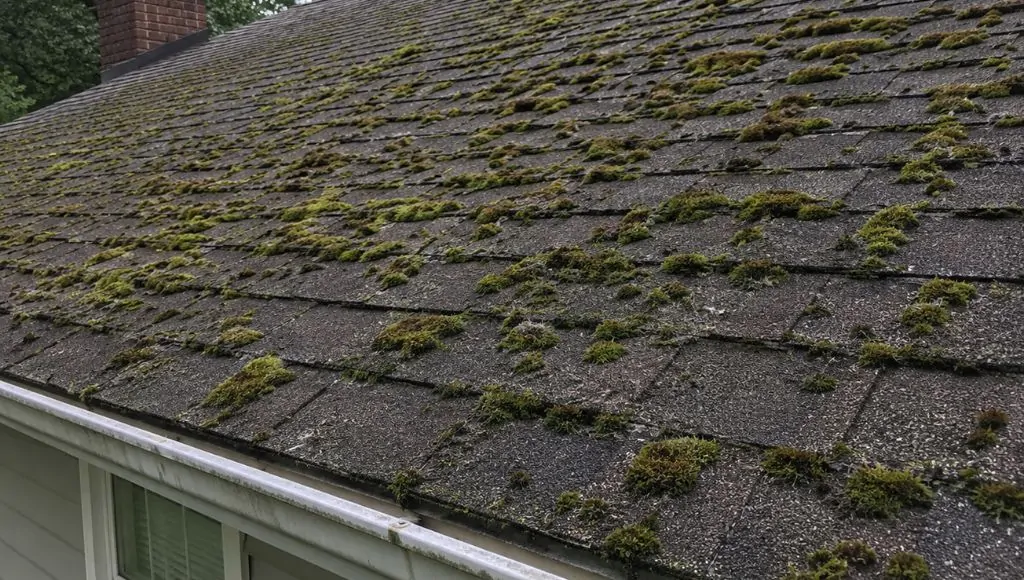
Smoke deposits don’t just cause chemical damage. They also create conditions that biological growth loves.
Ash and soot leave behind an organic layer on the shingle surface that holds moisture longer than clean shingles would. Add Northern Idaho’s shaded lots, tree canopy, and wet fall weather, and you’ve got near-ideal conditions for moss and algae to take hold.
Once moss establishes itself, it works moisture under shingle edges and accelerates deterioration from below, the part you can’t see from the ground. Smoke season in August or September can set the conditions for moss you won’t notice until spring.
Routine roof cleaning after fire season removes that residue before it becomes a biological problem.
What Smoke Does to Your Gutters and Downspouts
Dry ash is light and powdery. Wet ash, on the other hand, is a different story. It turns into a dense paste that clogs gutters faster than leaves do.
When gutters back up, water has nowhere to go except backward under the drip edge, against the fascia board, or into the soffit. That’s how a smoke season that seemed to pass without incident becomes a rot problem the following spring.
Watch for these signs after smoke season:
- Gutters that overflow during light rain
- Dark staining streaking down the fascia
- Standing water visible in gutters from the ground
- Downspouts that run slower than usual
Clearing gutters after smoke season, not just after the leaves fall, is one of the simplest things homeowners can do to protect their roofline.
Which Homes Are Most at Risk
Not every roof takes the same hit during wildfire season. Homes in or near forested areas, for example, absorb heavier deposits because smoke concentrates as it moves through tree canopies and settles in low-lying terrain.
In this region, the highest-risk areas include:
- Rathdrum Prairie, where open exposure to prevailing winds carries smoke from western fires
- Hayden foothills and lakeside neighborhoods, where the tree canopy traps particulate matter
- Coeur d’Alene’s hillside and wooded subdivisions, where slow-draining smoke settles during calm weather inversions
- Homes bordering state and national forest land with proximity to wildland-urban interface burn zones
Older roofs are more vulnerable than newer ones. A shingle roof that’s 12 to 18 years old has already lost a portion of its protective granules and asphalt oils. Smoke exposure accelerates the remaining lifespan in ways a new roof wouldn’t experience at the same rate.
Post-Smoke-Season Cleaning and When to Call a Pro
Some post-smoke cleanup is safe to handle yourself. Some of it isn’t.
| Task | Safe to DIY? | Notes |
| Clear gutters and flush downspouts | Yes ✅ | Do this before the fall rain season begins |
| Visual inspection from the ground | Yes ✅ | Look for dark staining and debris in valleys |
| Rinse siding and window sills | Yes ✅ | A low-pressure garden hose is fine |
| Pressure wash the roof | No ❌ | Pressure washing strips granules, and may void some warranties |
| Walk on an older roof to scrub shingles | No ❌ | Risk of breaking brittle shingles |
| Clean moss or algae growth off shingles | Hire a Pro | Requires soft wash and correct chemistry |
Professional roof cleaning uses a low-pressure soft wash process that removes ash, biological growth, and residue without disturbing granules or sealant strips. It’s the right tool for what smoke season leaves behind.
Why a Roof Inspection Before Winter Is Worth It

An inspection after fire season catches the things you can’t see from a ladder, and definitely can’t see from the ground.
A trained eye knows to look for:
- Granule loss in valleys and on south-facing slopes, which shows up as bare dark patches
- Cracked or lifted sealant strips between shingles
- Flashing corrosion at chimneys, vents, and skylights
- Soft spots on the decking that indicate moisture intrusion
- Gutter condition along the full roofline
The reason timing matters is that North Idaho winters put a snow load on your roof for months at a time. A smoke-damaged roof with compromised flashing or loosened shingles is more likely to fail under that load than one that went into winter in good shape.
Remedy Roofworks offers roof inspections with no obligation and a written summary of our findings. If the roof is in good shape, we’ll tell you that. If there’s something worth addressing before the first snow, you’ll know exactly what it is and what it costs to fix.
Ready to check your roof after smoke season?
Call us at (208) 551-5703 or request your free estimate online. We serve Hayden, Coeur d’Alene, Rathdrum, Post Falls, Spokane, and surrounding communities, and we’re happy to take a look before winter sets in.